Principles
Starting from the day my 4th grade class dove into the Hobbit, I voraciously read fantasy books. They were an escape into wondrous worlds where I could live a thousand lives. This not only fostered my love of independence, creativity and vision – it also left me with a deep sense that one should live by a code of higher ideals that guides right action in the face of challenge.
As I progressed from the naivete of youth through the complex nuances and conflicts of the real world, I found that having a consistent set of operating principles is more, not less, important.
Life throws an endless stream of choices at us. Without grounded reasoning, it’s easy to get swept into short term or localized decision-making at the cost of what more sober contemplation would reveal. A coherent set of principles grounds our choices and actions in our ideals and values.
Ideals, Values and Principles
The idea of a “code to live by” actually contains several concepts wrapped together, particularly ideals, values and principles.
Ideals are a pure aspirational vision of the abstract world we’d like to see. They are directional but not obtainable, like Justice, Enlightenment, Universal Compassion, and so on. They answer the question “what is the best possible version of this?”
Values express our internal preferences and guide tradeoffs between actions. They represent what we care about, as expressed through our emotional and moral priorities. Values might include Honesty, Freedom, Creativity, Family, and so on. They answer the question “what matters to me?”
Principles are both more universal and more practical. They are a set of operational rules you commit to following across situations which help to make decisions under pressure and constraints, but which also scale beyond the individual. They answer the question “how do I act in a messy situation?”
Each of these concepts has a failure mode. Ideals can become utopian and lean on unrealistic moral purity. Values can be vague and self-serving without creating action. Principles can become rigid and dogmatic. Ideals without principles are just philosophizing. Values without principles state what you care about but don’t match it with action. Principles without ideals are efficient but soulless.
Each principle also contains a shadow side. If its light represents when the principle is pulled toward its best ideals, the dark represents when it is co-opted, imbalanced or bastardized towards other ends. I value meritocracy, but it can drive structural inequality. I value fairness, but over-emphasis can restrict freedom of choice. I value reducing suffering but not anesthetizing the human experience. Liberty is often used to justify irresponsible selfishness. Sustainability can tip into stagnation. Even the pursuit of flourishing can fall into frivolous commodification.
The most ardent supporters of a principle are often those who get pulled into its shadow, typically while vociferously defending it. Avoiding the shadow requires critical thinking and even-handedness when asking “does this support just the shallow, skewed, short-term version of the principle or a deep, balanced, long-term version of it?”
Designing my Principles
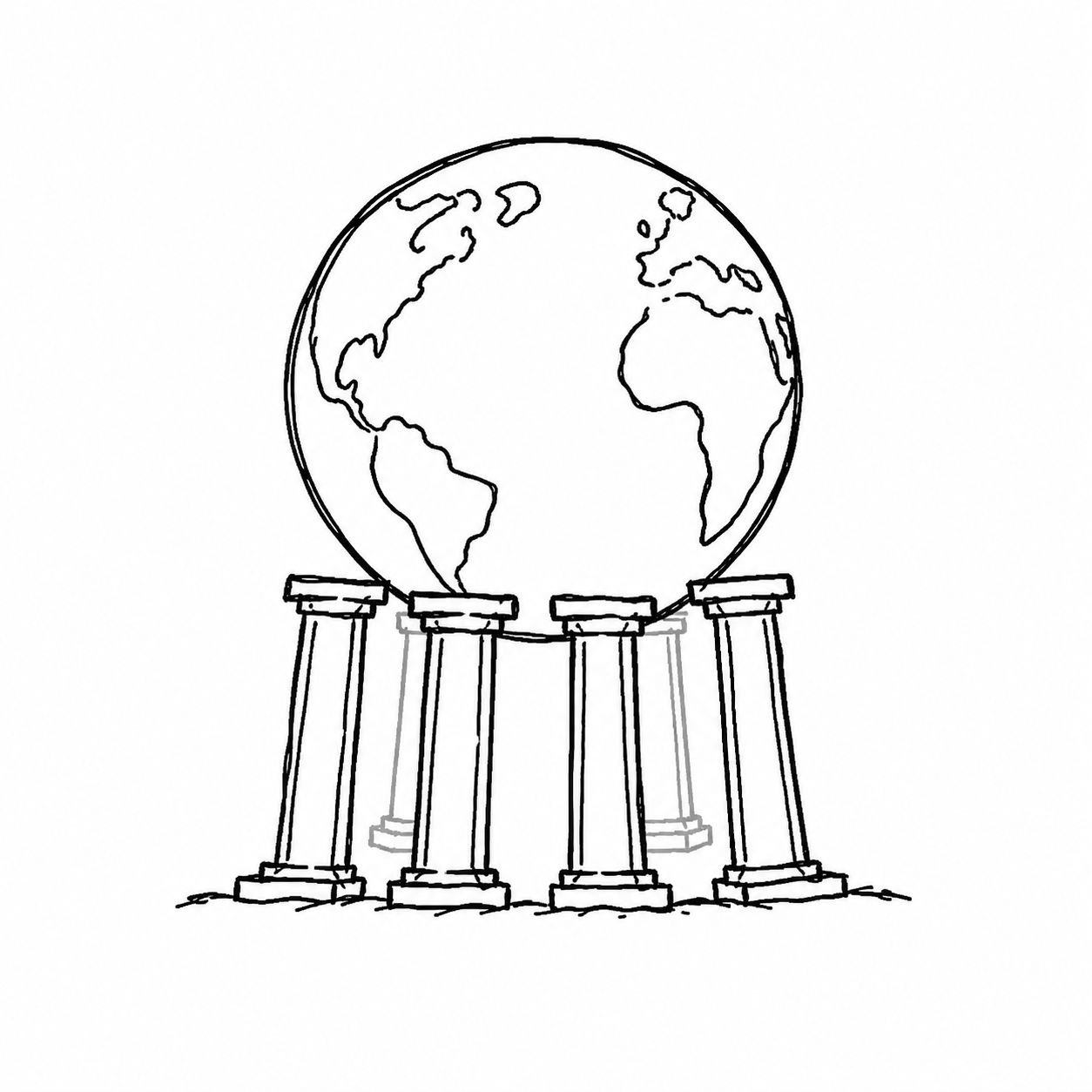
Below are the living principles that I believe are necessary to guide a just and sustainable future for humanity. They build on the foundation of the individual but encompass all of society and the planet we inhabit. I will support and champion any cause that appears to bring us towards realizing these.
I’ve married ideals, values and principles together but, because the intent is ultimately practical, I call this operating framework “principles”. It is designed to orient towards what’s right, to acknowledge inherent tradeoffs and to ultimately prioritize what should be weighed in a decision to act.
These are my own but I also hold them to be universally applicable. At the broader scale, they function more like design criteria for a better world than just a toolkit for making good decisions.
- WELLNESS [Your foundation]: All people should have access to the physical, mental and social conditions for healthy and dignified living, including sleep, diet, exercise, purpose and belonging.
- 🟡Light: Integrated care, prevention, resiliency, balance, belonging
- ⚫Shadow: Hedonism, medicalization, coercive health, conformity
- FAIRNESS [Your fresh start]: All people should be given equal opportunity to realize their best lives via a level playing field and a supportive system
- 🟡Light: Opportunity, dignity, meritocracy, transparency
- ⚫Shadow: Rigidity, grievance, victimhood, structural inequality, suppression
- LIBERTY [Your options]: All people should be free to express themselves and live a beautiful life with dignity and privacy.
- 🟡Light: Freedom of belief, expression, and association.
- ⚫Shadow: Selfishness, individualism, irresponsibility, justified harm, anarchy
- CONTRIBUTION [Your responsibilities]: All people should help to sustain and grow our shared communities, wisdom, and commons.
- 🟡Light: Service, civic engagement, participation
- ⚫Shadow: Martyrdom, performative altruism, coerced duty
- FLOURISHING [Your fulfillment]: All people should be able to experience the wonder and meaning that makes a life truly worth living.
- 🟡Light: Meaning, wonder, creativity, joy, alignment
- ⚫Shadow: Escapism, narcissism, frivolity, shallowness, commodification
- SUSTAINABILITY [Your future]: The systems we create to support our lives should be sustainably within the boundaries of our planet, its resources and its ecosystems.
- 🟡Light: Stewardship, circular economies, ethical technology, generational care
- ⚫Shadow: Eco-authoritarianism, puritanism, utopianism, stagnation
Each principle is necessary and, without it, a dystopian world is not difficult to construct because the other principles tend to get undermined as well.
A World like Ours
A world without wellness might look like gig economy hustles that keep us treading water, screen addictions that rob us of sleep, industrial food systems that make us ill, pharmaceuticals that addict us and social media echo chambers that erode our sense of belonging. Our bodies and minds would be eroded by chronic fatigue and anxiety, unable to savor the freedoms and abundances we’ve worked so hard for.
A world without fairness might look like a system where we’re sold the promise of upward mobility while elites entrench themselves at the cost of long term opportunities for the rest to advance. This would create simmering grievances that fester into populist backlashes, turning societies into powder kegs of resentment while retaining the language of equal playing fields.
A world without liberty might look like surveillance capitalism where big tech and governments use “product improvements” and “public safety” to justify everything from data panopticons to deplatforming in the name of harmony that incentivizes performative compliance. This would create a society where individual voice and vote are slowly but inevitably eroded through control mechanisms that are normalized as just and necessary.
A world without contribution might look like the atomized individualism of an influencer-driven culture where viral virtue-signaling replaces real civic engagement, public spaces and infrastructure decay amid tax avoidance and freeloading, communities splinter into tribal silos on apps and abundance breeds entitlement such that the dwindling few who hold it together burn out faster every day.
A world without flourishing might look like an existential void that hollows out our productivity-obsessed lives, where endless streaming and dopamine hits numb true creativity, comparative media commodifies joy and there is a pandemic of quiet despair that leaves us so disconnected that AI companions feel like upgrades from the human existence.
A world without sustainability might look like one where we binge on temporarily accessible resources while biodiversity crashes, pollution cooks the planet and new chemicals render us ever more prone to degradation. That would feed denial of scientific truth in service to profit, denial of wisdom in service of meme and denial of the reality of our own impact to create a predictable, slow-motion disaster for our children to inherit.
That each of these worlds so closely resembles our own is why it’s so critical to defend these principles while avoiding their shadows.
Scope and Time
There are two more concepts necessary to ground the principles above: scope and time. Without them, it’s possible for two people to agree entirely on the principles but still completely miss when it comes to implementing them.
Scope represents how much to weigh a narrow impact (eg to the individual) versus wide-radius impact (eg to the whole human race or planet). Selfishness overweights the individual, tribalism overweights the community you know personally and nationalism overweights our arbitrary borders. I personally try to balance my orientation between the up-close group that includes myself, my family and my known community and the more abstract planetary-scale mass of humanity.
Time affects all decisions because you always have to weigh the current moment against future moments in some ratio. Overweighting the short-term cashes all of our chips now and drives civilization towards a steep correction. Overweighting the far future can justify almost any action by comparing today’s paltry billions against interstellar humanity’s potential flourishing to trillions. Both orientations can leave our descendants worse off.
Personally, I apply a pretty steep discount to the future but do give it weight. I try to balance my orientation between the generations I will live to see (which will have my direct imprint) and those future generations I never will (who I must assume have mostly merged with the rest of humanity). This is why sustainability is such a critical principle – future generations should inherit a better world.
If I had to describe my own philosophy, it’s something like a pragmatic, close-weighted utilitarianism: improve joy and reduce suffering for the greatest number of people possible, but I will weight the ones closest to me slightly more.
Conclusion
These principles provide a compass and roadmap for decision and action. There will always be conflicts across their boundaries, particularly through scope and time. Where does my liberty begin and yours end? Where is my right to flourish counted against your childrens’ right to a sustainable future?
While it can be tricky to navigate conflicts between principles, the very act of distilling a problem to the level of principles means the approach is most likely to be consistent with a balanced framework for future success. Simply having principles breaks unhelpful binaries like left/right politics or the pressures of in-group tribalism because you can stand on and defend your own considered perspective.
If we’re targeting a better and more sustainable future for humanity that escapes our current predicament, then we’ll need more of that.